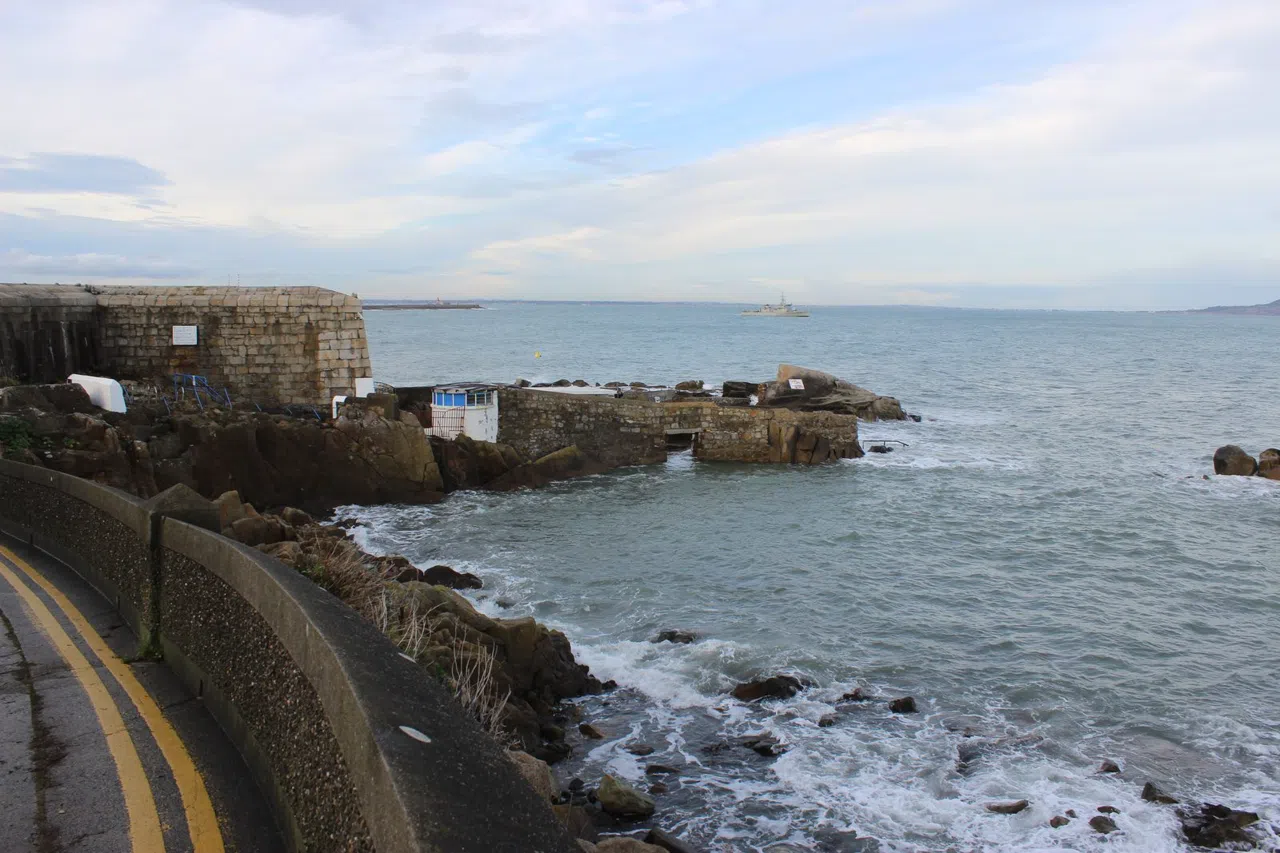

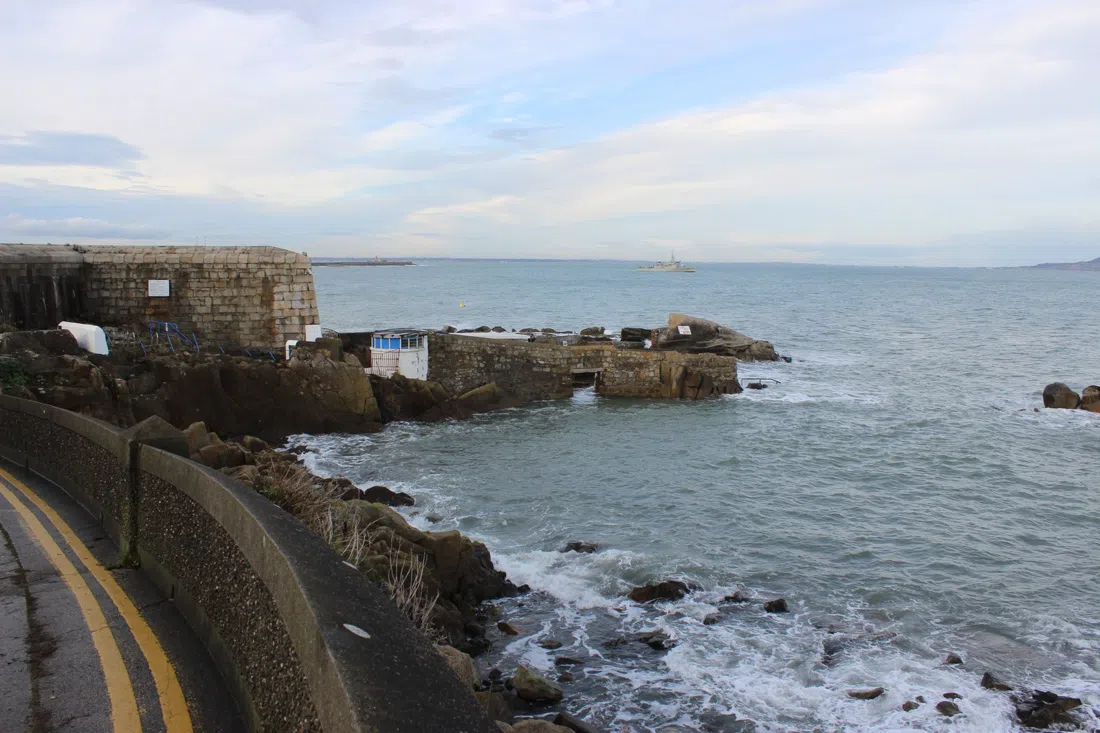
The granite at the Forty Foot is black with water at seven in the morning, and it does not much matter which morning. A man in his seventies goes down the steps without breaking stride, swims out forty strokes and back, and is dressed again in under four minutes. There is no gate, no fee, no lifeguard and no season. That stubborn ordinariness, more than the view across the bay, is what visitors come to stand beside.
The steps at the end of the DART line
The Forty Foot (Sandycove) is a low granite promontory on the southern edge of the bay, ten minutes on foot from Sandycove and Glasthule station, downhill most of the way, with the round Martello tower on the headland as your marker. People have been swimming off these rocks for more than 250 years. For most of that time it was a men's place by custom and then by signage, until women swam in and settled the argument in 1974, an afternoon locals still recount with some relish. It is also why the crowd you meet today is mixed in every sense: teenagers, nurses coming off nights, retired men with towels worn thin, a woman who has not missed a day since her husband died.
The swim itself is short. What makes it worth a traveller's time is that it never stops. There are dippers in the water here every day of the year. In August that means pre-work swims at dawn and a steady shuffle of bodies until dusk. In February it means four or five people at a time, a thermos on the wall, and conversation conducted in the clipped sentences of the genuinely cold.
Nothing at the Forty Foot will warn you, so be clear-eyed about the risk. It is a deep-water entry: no beach, no shallows, no gradual acclimatisation. You go down steps that are slick with algae and you are immediately out of your depth. There is no lifeguard and no staff of any kind. In an easterly the swell slams the rock and throws water over the top platform. On those mornings the regulars stand, watch, drink their coffee and go home, and a visitor should do exactly the same. Dún Laoghaire-Rathdown rated the water Excellent at the 14 September 2026 sampling, so the quality is not the concern; the sea state and your own cold response are.
Access is free, unstaffed and open around the clock, with no door policy of any kind. Groups of any size simply turn up. Changing happens in the open or behind the shelters, so a large party spreads itself along the rocks and gets on with it; nobody will comment, and nobody will help you either. On Christmas morning it is shoulder to shoulder, the ritual that makes the news photographs every year. Expect a crowd several deep at the steps, a long wait for your turn to jump, and a carnival atmosphere that has very little to do with what the place is like the other 364 days.
Two hundred metres of difference
If the steps look like too much, walk two hundred metres around the headland to Sandycove Beach (Sandycove) and you are in a different body of water entirely. This is a small, sheltered, sandy-bottomed cove that shelves gently, stays waist-deep a long way out and warms faster than anywhere else on this stretch of coast. It is where nervous swimmers acclimatise before they graduate to the rocks, and where families park themselves for an afternoon. The September 2026 sampling rated it Excellent too.
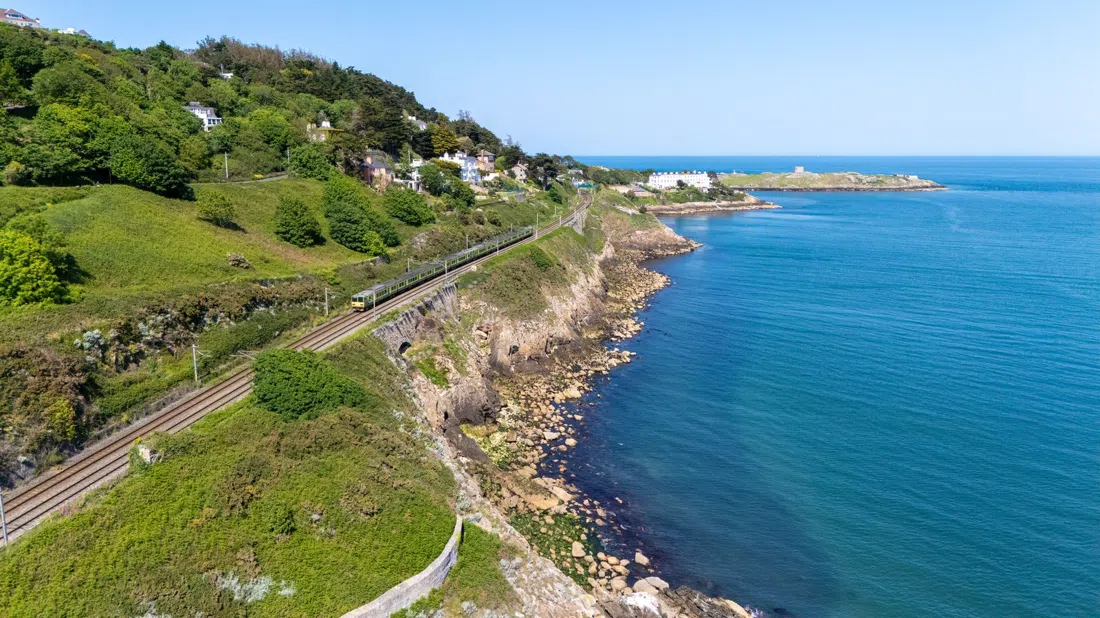
As a base camp it works better than the Forty Foot: there are benches along the top of the wall, a slipway to walk in from, and enough room to leave bags, towels and a flask with somebody sensible. Couples who want ten quiet minutes in the water rather than a test of nerve should start here, and may never feel the need to go further.
Learning it properly before you jump
The responsible alternative to teaching yourself cold water on granite steps is SwimCamp Ireland (sessions at Seapoint and Killiney), which runs small-group open-water clinics streamed by ability alongside one-off try-it-out sessions for complete beginners. Expect an ability check before anyone takes you into open water, and welcome it. Coaches handle the entry, the acclimatisation breathing and the first supervised swim, which are the three things that go wrong when a visitor arrives with a towel and enthusiasm.
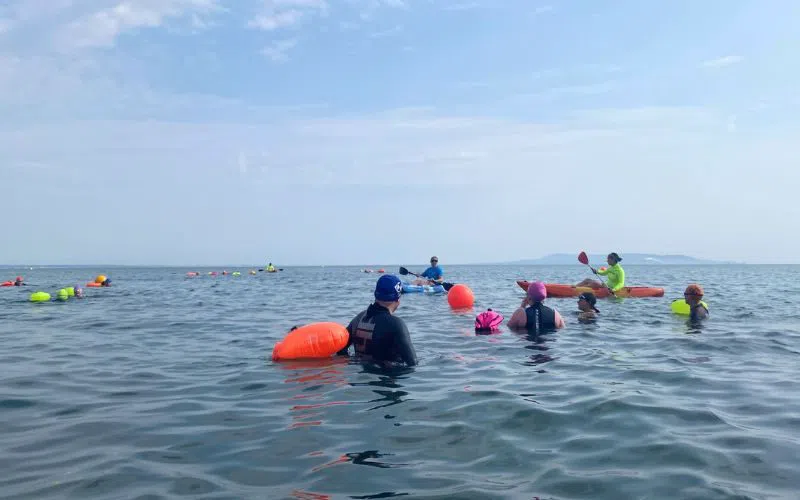
Reckon on roughly €15 to €30 for a single session and about €90 to €150 for a multi-week course. The low swimmer-to-coach ratio makes it genuinely suitable for a group of friends of mixed ability, which is a rarer thing than it sounds; it is also the only structure here that will tell you honestly that today is not your day.
The hot half of the habit
The Forty Foot has become a year-round habit for so many people, rather than a New Year's dare, because of the seaside saunas and the tight little loop they make possible: heat, walk, plunge, repeat.
Sandy Cove Sauna by the Sea (Sandycove) sits closest to the action, a wood-fired cabin roughly sixty seconds' walk from the water, and the only outdoor seaside sauna on the stretch between Glasthule and Dalkey. It opens 7am to 7pm, seven days a week, year-round, and costs somewhere in the region of €20 to €30 per person per session, more for exclusive use. It takes groups explicitly, with private hire for up to eight, and is openly marketed for birthdays and work outings. Book ahead; a wood-fired box that seats eight fills quickly on a Saturday, and turning up on spec in January is optimistic.
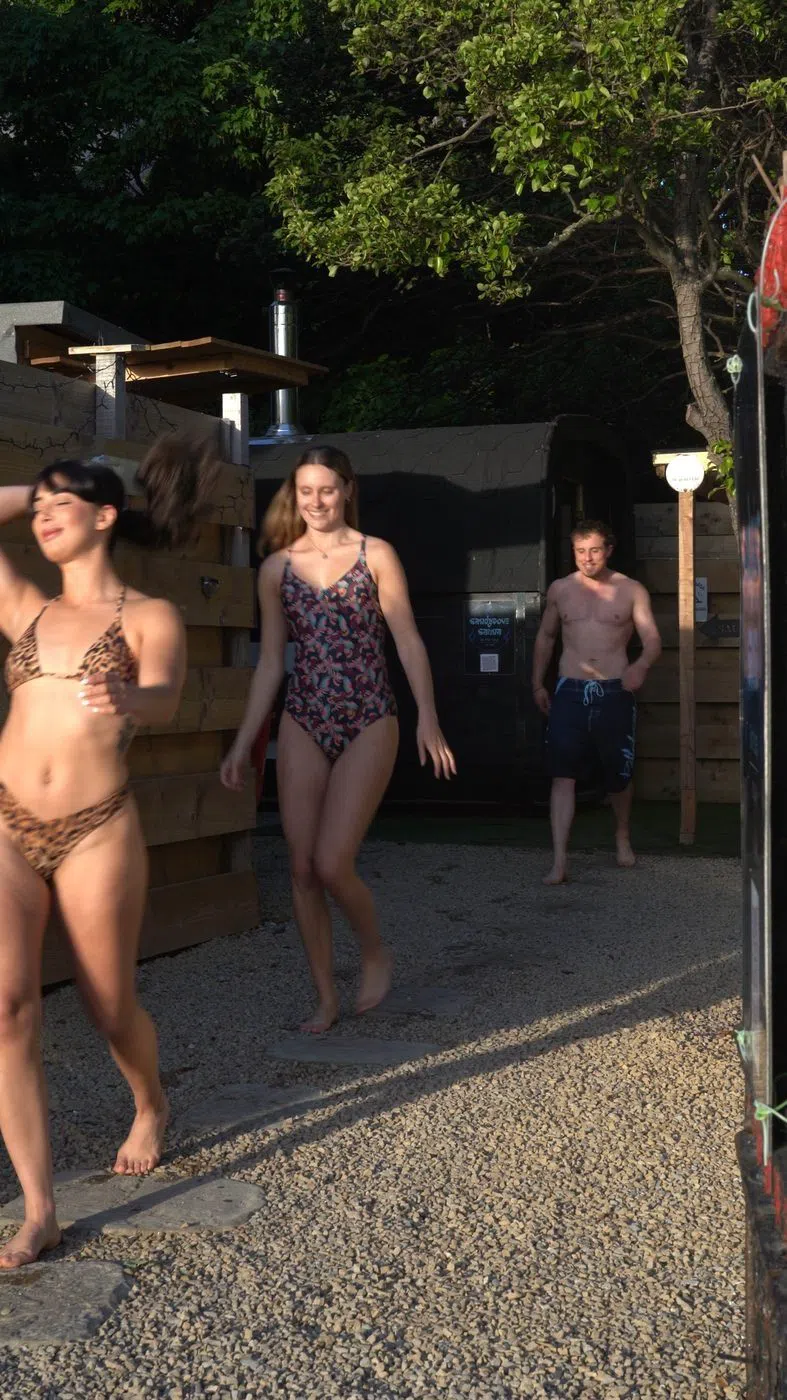
Helios Floating Sauna (Dún Laoghaire Harbour) is the newer and stranger option: Ireland's first floating sauna, launched with the county council in May 2026 and moored inside the harbour walls. A 45-minute session costs €24.95, or you can take the whole thing privately for up to twelve people at €260. It runs 8am to 10pm daily, online booking is advised and walk-ins are accommodated when there is space. For a visiting group that wants the hot-cold cycle without committing to an unguarded open-sea entry, this is the softest landing on the coast, and the late closing makes it the only one of these that works after a full day of sightseeing. Couples can buy single benches in a shared session; if you want the place to yourselves, you are paying the full €260, so do the arithmetic before you book.
The Victorian baths and the sign you should read
A fifteen-minute walk north along the seafront from the harbour brings you to Dún Laoghaire Baths (Newtownsmith), about ten minutes on foot from Dún Laoghaire DART. The €18 million restoration reopened the city's grandest Victorian bathing site with a purpose-built swim jetty, a changing shelter and a wide promenade, and it is free and public. Of everywhere on this list it is the easiest place to gather a big group: there is room to stand around without anyone being in anyone's way.
Be straight with yourself about the water, though. The EPA gave the site a 'poor' classification for the 2026 season on the back of two sewage incidents in 2025, and an advisory sign may be posted when you arrive. In practice every 2026 sample bar one has come back Excellent, so the classification reflects history rather than what is most likely in front of you on the day. Read the noticeboard before you get in, and never swim here within 48 hours of heavy rain. That rule is worth applying up and down this coast, not only here.
Where Dublin actually trains
Seapoint Beach (Monkstown) is the workhorse of the south side and the default meeting point for the city's swim groups, largely because the DART stops essentially on the beach. It held its Blue Flag again in 2026 and was rated Excellent in the September sampling. This is the most forgiving proper sea swim within easy reach of the centre: open water, real distance if you want it, but a sandy approach rather than a drop off rock.
Because coached sessions and club swims genuinely happen here, a large group is entirely normal and nobody will look twice at fifteen people in dryrobes. The one thing that will ruin your morning is tide: at low water you walk a very long way for a swim, and on a cold day that walk back across wet sand is worse than the water. Check the tide table the night before and aim for the two hours either side of high water.
Container ships and the Moonmen
For strong swimmers only, and the most atmospheric entry in the city, head out along the Great South Wall to the Half Moon Swimming & Water Polo Club (Poolbeg). Founded in 1898 as the Poolbeg Bathers Association, the Moonmen have kept a winter swimming tradition going for well over a century, in a setting no tourist board would have designed: power station chimneys behind you, container ships passing at genuinely close range, the city laid out flat and grey across the water.
You do not need to be a member to swim here or to use the shelter; it is free and open year-round. The walk out along the wall from the car park at the end of the Poolbeg peninsula takes a good twenty minutes each way and is a fine outing in itself for a group of any size or ability, particularly in a stiff wind. The swim is another matter: deep, cold, tidal and unlifeguarded, with shipping movement to respect. This is the expert's entry on this list, and the wrong place to discover you are not as strong a swimmer as you thought.
The quiet version on the north side
Everything above sits on the southern arc of the bay, which is where the habit is densest and the crowds are worst. The counterweight is The Sea Sauna at Tower Bay Beach (Portrane), north Dublin's original seaside sauna, on a quiet peninsula beach most visitors never reach. It runs shared 60-minute sessions at roughly €20 to €30 per person, plus private and dedicated group bookings for celebrations, seven days a week. It is over-18s only, and advance booking is advised.
The trip is the point. You are trading convenience for a beach where you may be one of six people, and getting the full hot-cold ritual without queueing for it. Donabate is the nearest DART station and you will want a taxi from there unless you fancy a long walk; going by car is simpler, and makes the whole thing a half-day rather than an hour.
Turning up with a group, or with one other person
Nothing on this coast has a door policy in the nightlife sense, but the practical realities differ sharply. The free sites (the Forty Foot, Sandycove Beach, the Baths, Seapoint and the Half Moon) absorb any number of people at any hour, and the only etiquette is not to block the steps while you work up your nerve. The saunas are the opposite: small, bookable, and effectively a private room once you take group hire, which is why they suit a birthday party of eight or twelve far better than a couple who will pay full private rates for the privilege of being alone. Couples are better served buying single benches in a shared session, or simply doing the Sandycove Beach and Forty Foot pairing at dawn, when there are more seabirds than people.
Practicalities
The DART does almost all of this for you: Seapoint, Dún Laoghaire and Sandycove and Glasthule are consecutive stops on the southbound line out of the city centre, roughly 20 to 30 minutes end to end, with trains every ten to fifteen minutes through the day. Tap on and off with a contactless card or a Leap card; a single leg costs a few euro. Everything from Seapoint to the Forty Foot can be walked along the seafront in about an hour if you would rather string the stops together than ride between them, and that walk (past the harbour, the baths and the cove, each with a different crowd doing a different version of the same thing) is the best way to understand why Dubliners are like this about the sea. The Half Moon and Portrane both need separate trips; neither is on this line.
The budget is simple. The swimming costs nothing, anywhere on this list. The saunas are the only real expense at €20 to €30 per person, or €260 for exclusive use of the floating one; coaching runs €15 to €30 for a session. Carry a card, because everything bookable here is booked online, but a little cash is worth having for coffee near the cove. Bring a towel that you do not mind ruining, footwear you can walk on wet granite in, and warm layers that go on fast: the cold that catches people out arrives fifteen minutes after they get out, not while they are in.
Timing is the one decision that matters. Summer dawns are the easiest introduction, with the water at its warmest, light from about five, and the pre-work regulars for company. Winter needs either a sauna in the plan or a coached session to keep you honest. Christmas morning is a spectacle rather than a swim, and if that is what you have come for, arrive early and accept that you will queue. For staying within walking distance of the coast, start with a Dublin hotel search around Dún Laoghaire and Monkstown rather than the city centre, and read our wider Dublin guide for how the rest of the city fits around a morning that ends by nine.